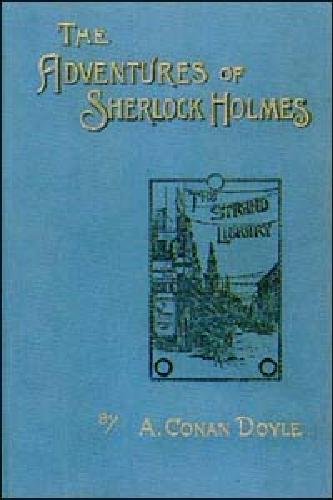
The Adventure of Sherlock Holmes
Doyle, Arthur Conan, Sir.
Fiction
5/5 stars
Usually in a story like The Adventures of Sherlock Holmes the characters go on some kind of journey, they progress, crisis comes, the audience is intended to learn an important lesson, and that is the end. But because The Adventures of Sherlock Holmes is a short story collection, that story line cannot be followed. Doyle designed these stories to be self-contained, so there is not much development across stories within the Adventures, though there might be some crossing of the stories here, and there over all they do not build on each other. Each story is very different. You can't compare 'Scandal in Bohemia' to 'Man with the Twisted Lip' to 'Hound of Baskerville' to 'Study in Scarlet'. Holmes doesn't always solve the mystery, there isn't always a murder, and there isn't even always a crime. There is no common plot.
One of the main themes in The Adventures of Sherlock Holmes is moral weakness: giving in to temptation, giving in to rage, giving in to the desire for revenge, and so on. Weakness is a general theme of the detective story as a whole, it is emphasized in The Adventures of Sherlock Holmes stories. Sir Arthur Conan Doyle writes over and over again about declining family fortunes, personal reputation, and social status as a result of moral weakness. In 'The Speckled Band', and also seen in 'The Man With the Twisted Lip' moral weakness is shown. One reason I think that this a big theme in the stories is because at the time the British Government is at the top of its game, and Doyle is subtly reminding the readers not to get cocky because once you are so far up, the only way is down.
The Adventures of Sherlock Holmes stories are fairly simple, they do not take long to read at all and they are very intriguing. They move quickly, so you do not get bored easily with the stories, and there is alway a new enticing twist at the end. The stories are narrated in first person by Dr. John Watson Sherlock's assistant, and only friend. Though there are four exceptions where Dr. Watson does not narrate the story.
I think that the book was intended to be read, at the time, by anyone who enjoys a mystery, and can understand the writing. Now I think that it is more difficult to understand the writing style, and some of the ways things are worded because we are not accustom to them. Though the writing is different now I think that the intended audience has stayed the same.
I would recommend this book to anyone, and everyone. It is engaging, and the stories never feel like you are rereading the same one. They are all different, and they are all exciting. This book was written in the late 18 hundreds, early 19 hundreds, so there are not many quotes on what people think of it, but the copies are still selling today, industries are making films, and series off the stories, so that could be a very good indicator that the stories are well loved still by many.